OLMo 3 Model Flow Overview#
OLMo 3 is a fully open-source model family with public data and code. This overview uses its model flow as an end-to-end example to show how data curation and evaluation are woven into each training stage.
The end-to-end flow at a glance#
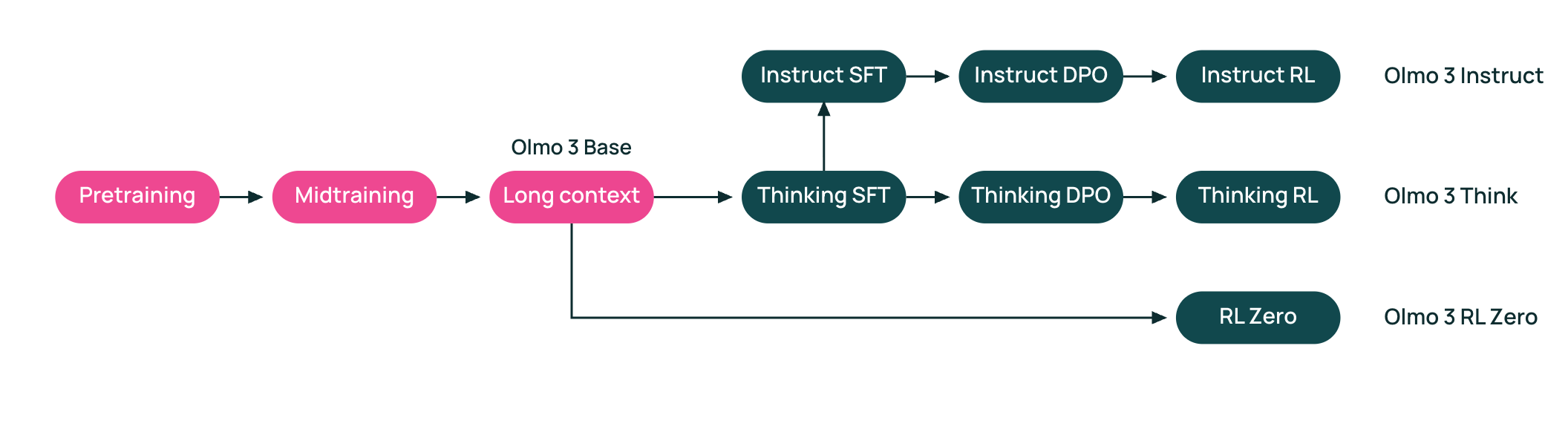
Base model training (7B and 32B):
Pretraining on large-scale, mostly natural data.
Midtraining on targeted data to move specific capabilities.
Long-context extension to train on long documents and tasks.
Each stage uses task-specific evaluations to decide what data to add, what to filter, and which mixtures are worth scaling.
Post-training:
After the base model, OLMo 3 applies a shared pipeline—SFT → DPO → RL—and branches into three model variants:
OLMo 3 Instruct: non-reasoning assistants optimized for chat, instruction following, and tool use.
OLMo 3 Think: reasoning models trained to produce explicit thinking traces before answers.
OLMo 3 RL-Zero: reasoning models trained via RL directly from the base model.
Although Instruct and Think use similar algorithms, their data curation and evaluation targets differ. The sections that follow unpack each stage of the flow and highlight how those choices shape model behavior.